
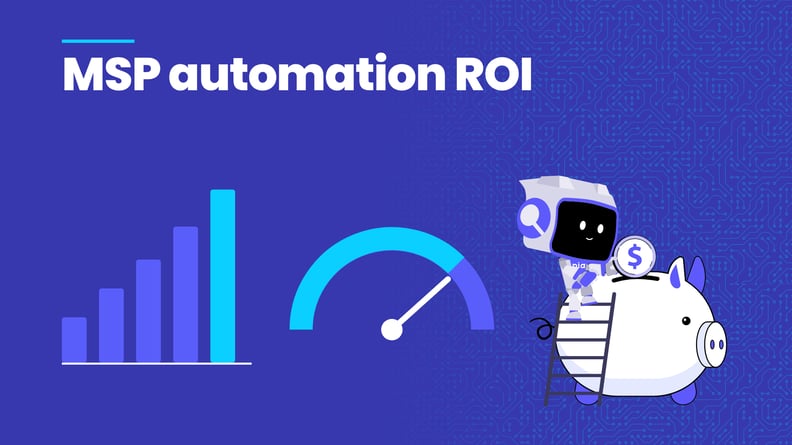

MSP automation ROI is best measured in margin and capacity. Look at outcomes: common issues resolved the same way every time, fewer handoffs, more clients supported by the same team, and margins that hold steady as you grow. Ticket volume tells you how busy the desk is, but it says little about whether the business is getting better.
How does intelligent automation affect MSP profit margins over time?
Automation protects margin by moving the work from individual effort to a repeatable process. Over time, the same team supports more clients without costs rising at the same pace.
Speed, cost and quality all matter, and traditional service models make it hard to improve all three at once. Many MSPs lean on senior engineers to fill the gaps. That works for a while, but it ties results to heroics, and heroics don't scale. These eight MSP cost drivers show where the savings tend to appear first.
To see the effect on margin, track four outcomes instead of tickets closed:
- Consistent outcomes: common issues are resolved the same way, with fewer escalations and less repeat work.
- Smoother workflow: tickets move with fewer handoffs and less reliance on senior engineers.
- Capacity: the business takes on more clients or more complex work without adding headcount.
- Stable margins: costs hold steady because the work is repeatable, so nobody has to work harder to keep up.
Pia CEO David Schwartz first laid out this framework in Measuring what matters: a smarter framework for automation ROI, originally published on ChannelE2E.
What should MSPs look for in an automation platform to cut operational costs?
Choose a platform that resolves requests end to end inside your PSA, is useful from day one, and records every action on the ticket.
Resolution matters most. A tool that only sorts tickets still leaves a technician to do the work, so the cost stays where it was. Look for automation that finishes common requests, like password resets and new user onboarding, with approvals where you want them.
Speed to value matters next. Pre-built automations mean you configure rather than build, and custom automations cover anything unique to your business. Finally, every action should land on the ticket, so your PSA reporting shows what automation actually did. That record is how you prove the return. For the numbers side, see IT cost reduction strategies and the ROI of automation and how to spot the right moment to scale.
How does Pia help MSPs get a return from automation?
Pia is the service delivery automation platform built for MSPs, and it takes a client request all the way to a resolved ticket inside ConnectWise, Autotask or HaloPSA.
AI Triage classifies each ticket and sends it to the right place. From there, 100+ pre-built automations resolve the most common requests, and your team can build custom automations for the rest. Every step is logged on the ticket, so the PSA stays your system of record and your ROI shows up in the reports you already use.
"It's enabled us to grow without having to also grow our head count." Dan May, Managing Director, ramsac.
Explore Pia's pre-built automations
Frequently asked questions
What is MSP automation ROI?
It is the return an MSP gets from automating service desk work. The clearest way to measure it is by outcomes such as consistency, capacity and margin.
Is ticket volume a good way to measure automation ROI?
Not on its own. Closed tickets show activity, but they don't show whether work flows better or costs less to deliver.
How quickly can an MSP see a return from automation?
With pre-built automations you configure rather than build, so you can start resolving tickets with automation within weeks. Margin gains build as the same team takes on more clients.
Pia is the service delivery automation platform for MSPs, combining client self-service with proprietary ticket classification and automation, all inside the PSA, so teams scale without headcount. Learn more at pia.ai.