

Most MSPs agree that embracing automation is an effective IT cost-reduction strategy. But how to actually measure the savings? That's where things get fuzzy.
Ticket volume alone has become the default metric, but that number only tells a fraction of the story. It doesn’t show how automation helps issues get resolved faster, improves consistency across your team, or frees your techs to work on more valuable and strategic projects.
And it definitely doesn’t show how these operational improvements lead to measurable IT cost reductions.
If you’ve ever looked at your reports and thought, “I know automation helps, but I can’t prove it,” you’re not alone. Many MSPs feel pressure to show a clear ROI but struggle with where to start or how to benchmark their progress.
The good news? With the right framework, you can measure the ROI of automation in a way that aligns with how modern MSPs actually work, and build an IT cost-reduction strategy that’s rooted in truth, not guesswork.
Why automation ROI is so hard to measure
A big part of the problem is that MSPs classify and track things differently, which makes it hard to measure value consistently.
Ticket categories vary. Time entries aren’t consistent. There’s just not enough data to easily measure the ROI of automation.
That makes leaders default to surface-level metrics. But focusing on “number of tickets closed” or “number of endpoints supported” misses the deeper value of automation and AI as an IT cost reduction strategy.
When done correctly, automation and AI can help MSPs achieve the elusive “golden triangle”: delivering fast response times and consistent service at a price clients can actually afford.
In the past, many MSPs could deliver two of the three, but without the right tools, you had to rely heavily on senior engineers to achieve all of the above. That creates a ceiling on how fast the business can grow and keeps revenue consistently tied to headcount.
Automation breaks that pattern.
When you apply intelligent automation and AI to the right workflows, you improve margins, service quality, and customer satisfaction, all at the same time. And instead of wasting time on repetitive tasks, your techs can now focus on work that actually matters.
That’s the real ROI of automation.
The misconceptions that hold MSPs back from achieving the full ROI of automation
Based on the conversations we have with MSPs, many leaders run into a few common misconceptions that make automation seem more complicated or risky than it really is.
Myth #1: Automation ROI is achieved by simply eliminating IT jobs
In reality, our MSP partners report the opposite. When routine work is automated, junior techs move into more complex work faster, senior techs stop drowning in noise, and teams feel less burnt out.
Myth #2: Automation tools are too hard to implement
Many MSPs believe that fully embracing automation and AI requires hiring a specialist or drowning techs in a months-long implementation. And yes, that’s the reality with some of our competitors.
But not all AI tools are built the same. More on what makes Pia different in a minute.
Myth #3: There’s time to wait and see if AI is an effective IT cost reduction strategy
Market conditions say otherwise. Expectations keep rising. Margins keep tightening. Delaying automation doesn’t protect your operations, it introduces more risk.
Where MSPs go wrong in calculating ROI
Another place MSPs get stuck is putting effort into automations that look impressive but don’t actually solve real issues.
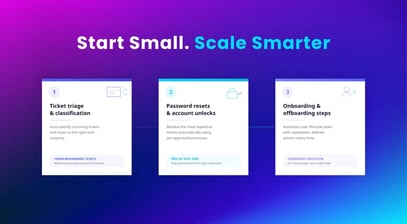
For example, it’s easy to get excited about building an AI workflow that tags ticket sentiment and posts alerts in Slack. But automating user onboardings so they take minutes instead of hours will have a more meaningful impact on your margins, efficiency, and client experience.
Automating password resets, terminations, mailbox permissions, and triage may not sound glamorous, but they deliver the strongest ROI.
MSPs who anchor their automation planning to value, not novelty, are the ones who will see the biggest impact. And the biggest savings.
The metrics that truly matter when it comes to AI and automation
When you measure the things that actually matter, automation’s impact is easier to prove.
Instead of tracking how many tickets were“touched,” focus on the operational and financial levers tied to profitability:
Resolution speed
Are issues getting resolved faster because there are fewer handoffs?
SLA compliance
Are you still fixing issues within the time frames you promise clients, even when the queue is blowing up?
Technician utilization
How much time is shifted from low-value work to more strategic, profit-driving projects?
First-contact resolution
Are techs solving more issues without escalation?
Customer satisfaction
Do clients see faster turnarounds and few errors?
Gross margin and net dollar retention
Are clients staying longer because service quality is more consistent? Are you increasing revenue per client because your team has more capacity?
How Pia helps you maximize automation ROI and achieve real IT cost reductions
Once you start measuring automation through outcomes like speed, consistency, and capacity, the strategy becomes clearer.
You stop chasing the work that only looks impressive and start prioritizing the workflows that reshape how your team operates. You see where your time goes, where clients feel friction, and where automation creates the biggest ROI.
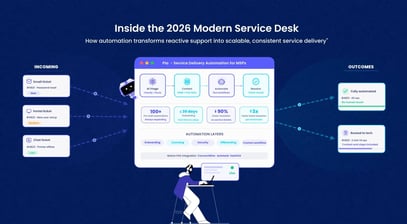
That’s where Pia comes in. Pia follows your process from start to finish and automates the repetitive work that slows teams down.
With 60+ out-of-the-box automations and easy integrations with all the major PSAs and RMMs, Pia helps you deliver faster resolutions, more consistent service, and pricing clients can actually afford.
In other words, the exact outcomes MSPs have been trying to achieve for years.
If you want a clearer way to prove the ROI of your automation work and a platform that helps you get there faster, visit pia.ai.