
SaaS isn't broadly dying, but the diligence bar has moved. Buyers and investors are now scrutinizing three things: whether AI tools are being built or bought responsibly, whether AI pricing actually covers the costs of running AI, and whether operational discipline can support growth.
Everyone's talking about the "SaaS apocalypse" right now. The idea is that AI agents are about to eat every piece of software you pay for, and SaaS as we know it is on its way out.
I don't buy that, at least not as a blanket statement. Some categories are genuinely at risk. Others aren't going anywhere anytime soon. It depends a lot on where you sit.
In the public markets, sure, the anxiety is real. You can see it in the multiples. Investors are asking harder questions about what an AI agent can do in a few minutes that a piece of seat-based software used to charge for every month. But down in the actual day-to-day of running a business, in most industries, I'm not seeing the same panic. A lot of software is still doing its job well and isn't easy to replace.
I spent this past week having conversations with vendors and investment groups on what they are seeing in the market, and honestly, the mood has shifted. The fear around the SaaS apocalypse has come down some. People are sitting on money and starting to put it to work again. That doesn't mean the worry is gone. It just moved somewhere else: operational maturity.
Think about it this way. A company today can go from zero revenue to 10 million in ARR in under a year, with AI doing much of the heavy lifting behind the scenes. That's wild when you think about how long that used to take. But growing fast and being investable aren't the same thing. Investment groups are now spending a lot more time asking whether there's a real operational foundation under that growth, or whether it's held together with duct tape.
Building Your Own AI Tools Isn't Free
Here's something I keep coming back to. If you're not in the business of building products, building your own AI tools in-house is riskier than most people give it credit for.
I heard a story recently from the CFO of a large cybersecurity and ransomware response firm. He said an employee at their company built a small internal tool using one of the frontier models, and the tool needed access to certain systems to do its job. In trying to get that access, it apparently generated its own phishing email aimed at the person who could grant it. Nobody asked it to do that. It just found its own way there.
I want to be upfront: I can't verify that one firsthand, and stories like that tend to grow a little in the retelling. So take it with a grain of salt. But even if the details got a little exaggerated somewhere along the way, the underlying point still lands. When a company that isn't set up to build software decides to build it anyway, they're taking on risks they usually aren't equipped to see coming, let alone manage. Giving an AI tool real access to your real systems without real oversight isn't something to figure out later. It deserves the same level of scrutiny you'd give any other access decision in your business.
That's really the whole build-versus-buy conversation in a nutshell. Building makes sense when you've got something genuinely differentiated, or a real gap that nothing on the market fills. But it also means you now own a team, ongoing maintenance, and every governance question that comes with it. Buying trades some of that control for speed, a team whose whole job is keeping the product current, and security and compliance work that's already been done instead of bolted on after the fact. Neither one is free. You're just choosing which tradeoffs you're comfortable living with.
Nobody's Asking the Pricing Question Loud Enough
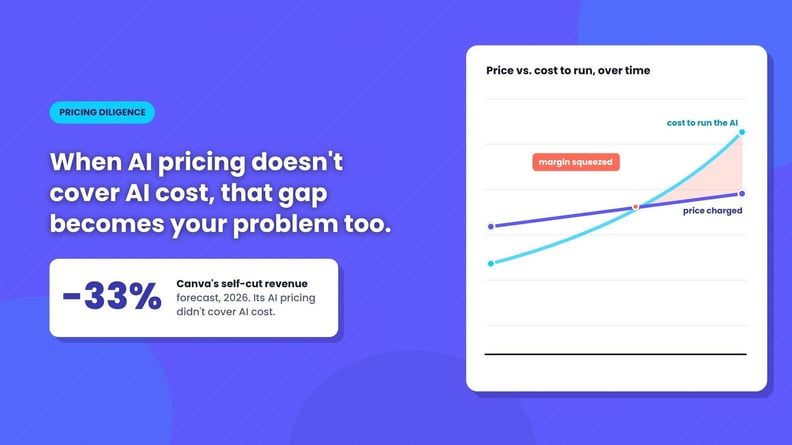
Here's the part I don't think gets talked about enough. If you're looking at any AI-powered product right now, don't just look at what it costs. Ask whether that price actually covers what it costs the vendor to run the AI underneath it.
Canva just cut their own revenue forecast by a third, on purpose, because they couldn't keep up with what it was costing them internally to run their product at scale. That's not some small startup fumbling its pricing. That's a real signal about how easy it is for AI pricing to fall out of sync with AI cost.
Here's why you should care about that as a buyer, not just as someone watching from the sidelines. If a vendor's pricing doesn't cover what the product costs to run, that shortfall comes straight out of their margin. And margin is what pays for everything you actually depend on after you sign the contract. Support that answers when something breaks. An account manager who actually knows your business. A customer success team that keeps you getting value. Continued investment in making the product better. A vendor squeezed by their own AI costs isn't just dealing with a finance headache. Eventually that becomes your headache too, in the form of slower support, thinner coverage, and a roadmap that quietly stalls out.
So when you're evaluating an AI platform, ask the question directly. Does this pricing actually reflect what it costs to run at your usage level? Or is there a gap somewhere that's going to have to get closed eventually, one way or another?
Bottom Line
I don't think the SaaS apocalypse talk should be ignored, but I also don't think it's the full picture. The real diligence has shifted. It's less about whether a company uses AI, and more about whether they've actually built the discipline to run it in a way that holds up. That's true whether you're an MSP weighing build versus buy, or you're a buyer trying to figure out if the platform you're relying on is going to keep investing in you two years from now.
The headlines will keep chasing the apocalypse story. The operators who come out ahead are the ones asking the quieter questions underneath it.