
Most MSP leaders all agree on one thing: AI adoption is no longer optional.
The problem is knowing where to start and how to build an AI roadmap that doesn’t disrupt the service desk, alienate technicians, or put client data at risk.
The truth is AI maturity is not just a technology problem. It’s also a process, data, and adoption problem.
If your ticket intake process is chaotic, AI will only scale the chaos faster. If your naming conventions are all over the place, AI will only amplify the inconsistencies.
The goal is not “using AI.” The goal is developing a controlled and auditable AI roadmap that allows you to close more tickets with less friction.
In this guide, we break down a practical AI maturity model for MSPs. We’ll show you where to get started. How to build deliberate and repeatable workflows. And how to prove ROI by tying each step of your AI roadmap to everyday IT help desk problems.
And we’ll show you how to do all that in a way that protects your margins, while proving to your current team members that AI is here to make their lives easier, not replace them.
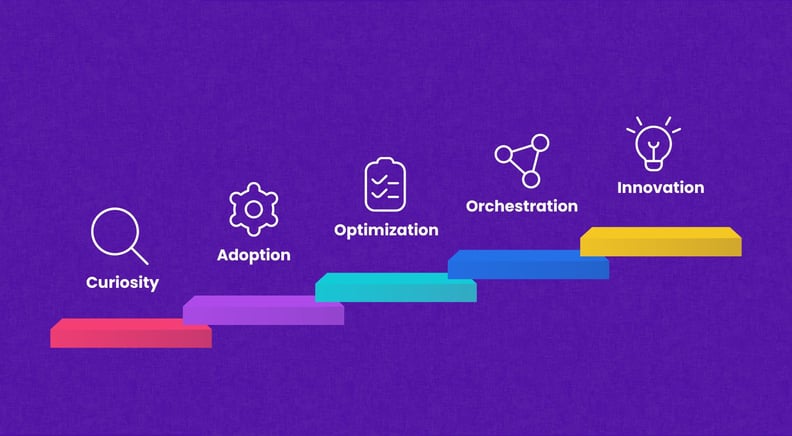
The five stages of AI maturity for MSPs
AI maturity doesn’t happen all at once. It’s something you develop over time, as your workflows, data, and processes evolve.
Based on conversations with partners, we’ve seen this progression fall into five clear stages.
Each one solves a specific set of problems and prepares your service desk for what comes next.
Stage 1: Curiosity
The curiosity stage is all about experimentation.
It usually starts with a nudge. A client asks about your AI roadmap. You see a competitor talking about automation on LinkedIn.
Or your techs are clearly burned out, spending too much of their day resetting passwords and reworking the same tickets. AI starts to feel like a logical next step.
Individual techs may already be using AI tools informally. Leaders are sitting through vendor demos. There's a lot of interest, but no formalized standards, no consistent outcomes, and no clear “why” behind your AI adoption strategy.
This is also where many MSPs run into their first real AI roadblock: the data just isn’t ready.
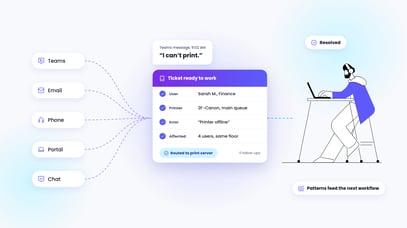
Ticket classification varies by technician. Categories are loosely defined. The same request shows up five different ways in the system.
That makes it hard to see patterns, quantify effort, or identify what’s actually worth automating. Without that clarity, experimentation stays fragmented and progress stalls.
But don’t worry. Because at this stage, the goal isn’t precision. It’s awareness.
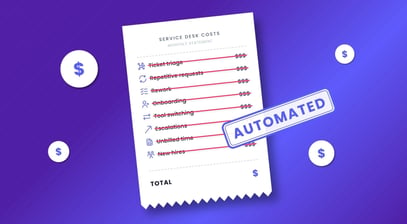
You’re trying to understand how much AI experimentation is already happening, where the ticket volume is really coming from, and how much time your team is losing to the same repeat work.
Stage 2: Adoption
At this stage of the MSP AI roadmap, automation has to start earning its keep. But the goal isn’t complete transformation. It’s finding a specific service desk workflow or process that AI can take off your team’s plate.
Start with the boring stuff: password resets, account lockouts, basic onboarding or offboarding steps.
These are the tickets that show up every day, interrupt your team’s flow, and quietly drain everyone’s time and energy.
At this stage, you may find yourself forced to make your data and processes more consistent. Which is a good thing.
Permissions get defined. Approvals are clarified. Rules for what automation needs approval and which can run unattended are set upfront.
As your AI roadmap evolves, the changes start to show up in small but meaningful ways.
The same request takes less time today than it did last month. Approved automations handle what were once tedious time-wasting tasks. Error and rework rates start to drop.
Most importantly, the team stops debating whether AI is useful and starts asking what to automate next.
Stage 3: Optimization
At this point, AI is already starting to prove its value. Tickets are closing faster. The team trusts the outcomes. And because things are finally moving, any remaining data or workflow inconsistencies become harder to ignore.
Teams are forced to start paying closer attention to how work enters the system. The ticket intake process becomes more standardized. Fields, categories, and approvals are handled consistently. Identity and tenant hygiene improve with clearer naming conventions, group logic, and licensing rules.
The goal isn’t the pursuit of perfection. It’s making this more consistent and clear so AI and automation can handle more grunt work, while allowing your team to focus on higher-value work.
This stage isn’t flashy. But it’s where automation stops feeling like a collection of clever workflows and starts behaving like something you can actually depend on.
Now, standard requests are handled the same way every time. Manual touchpoints drop. Variance shrinks. And techs spend less time fixing edge cases and more time moving work forward.
Stage 4: Orchestration
Once the basics are in place, you go from just “running scripts” to automating full help desk workflows with complete visibility and control.
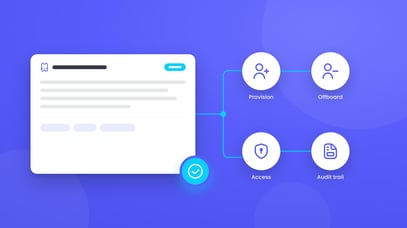
All of your systems, third-party tools, identity platforms, documentation, and data are connected. Requests don’t just start faster. They finish cleanly. Each action happens in the right order, with the right context, and with clear visibility into what ran, what didn’t, and why.
At this stage, automation can also make your MSP business more secure. Role-based access ensures only the right people can approve sensitive actions. Audit trails make changes traceable. If something fails, it’s visible, recoverable, and fixable.
Life also starts to feel easier for everyone on the team. After-hours manual work drops. The number of tickets each tech can handle increases without additional stress or context switching.
And for the first time, scaling doesn’t depend entirely on adding more work to your current team’s plates or increasing your headcount.
Orchestration is where automation stops living inside individual workflows and starts operating like part of the service desk itself.
Stage 5: Innovation
When AI and automation become embedded in your everyday workflows, you’re finally able to shift from reactive firefighting to preventing problems (and tickets) from showing up in the first place.
Patterns start to stand out. Recurring issues show up clearly across clients, sites, and users. Trends point to where capacity, configuration, access, or hygiene needs attention. Each month, the next high-friction category gets addressed, automated, or eliminated altogether.
Innovation isn’t about chasing the latest trend, it’s about finding ways to proactively prevent issues while improving SLA and CSAT trends, and increasing EBITDA. Not because the team is working harder, but because fewer problems make it into the queue in the first place.
Innovation isn’t a finish line. It’s a loop.
Turning the AI maturity model into action
The goal of an AI maturity model is to help you make better decisions by understanding where you are today, what’s slowing you down, and how to move forward deliberately.
Without that clarity, it’s easy to jump ahead, add complexity, or automate the wrong things.
Pia’s approach to AI maturity is built around understanding real service desk workflows, establishing clear guardrails, and working towards measurable outcomes.
It follows your processes from start to finish, so automation strengthens control instead of weakening it. And it helps teams move from experimentation to orchestration without losing trust, visibility, or confidence along the way.
If you’re ready to move your AI maturity roadmap forward with intention, book a demo to see how Pia’s automations and purpose-built AI can make your help desk more scalable and consistent.